
What Bit Me?Free AI Bug Bite Identifier
Upload a photo and get possible bite matches, safety signals, and next steps in seconds. Educational comparison — not a medical diagnosis.
- Free
- Educational, not medical diagnosis
Upload a photo
 Stinglo
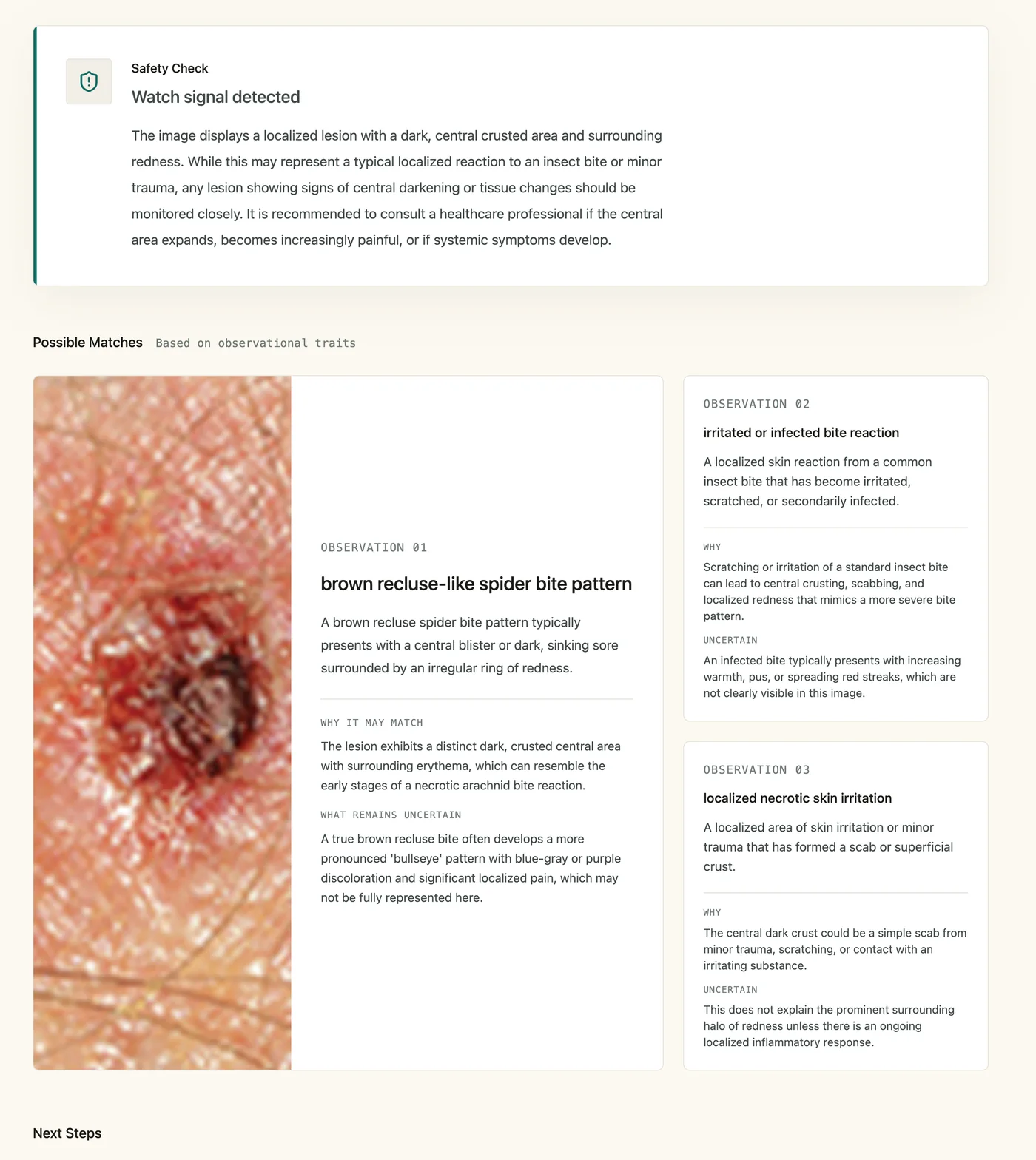
Bug bite identifier example report: what Stinglo returns.
A bug bite identifier should show its work. This sample report previews the exact output shape: safety first, possible matches second, and practical next steps last.
 Stinglo
How this bug bite identifier reads photo and symptom signals
A photo alone is not enough to compare a bite well. Stinglo looks at the image alongside location, sensation, duration, and pattern changes, because itching, swelling, clusters, lines, and ring-like redness can overlap across common bites. The goal is a clearer educational comparison, not a certain insect name.
StingloBug bite identifier pictures: compare patterns, not certainty.
Use photos as a starting point for comparing shape, grouping, swelling, itching, timing, and body location. Mosquito, bed bug, flea, tick, spider, ant, sting, and mite-like marks can overlap, so the guide uses compare-and-watch language instead of treating one picture as proof.


 Stinglo
Bug bite identifier pattern guide: compare before guessing.
Many bug bite identifier searches start from the mark itself: a line, cluster, ring, blister, swelling, or unusual sensation. Stinglo separates pattern clues from insect names so the page covers how people actually describe a bite.
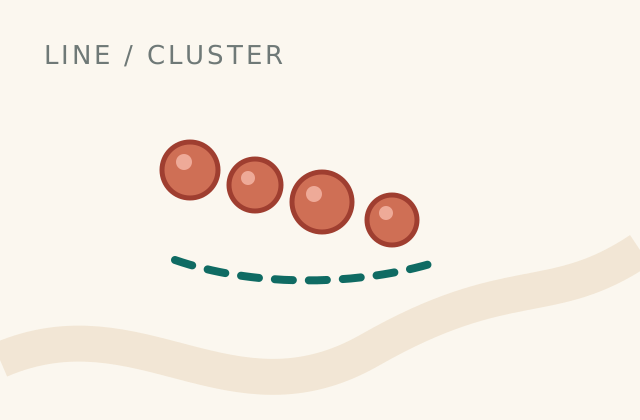
Grouped or row-like marks can fit bed bug context, flea exposure, irritation, or repeated scratching.
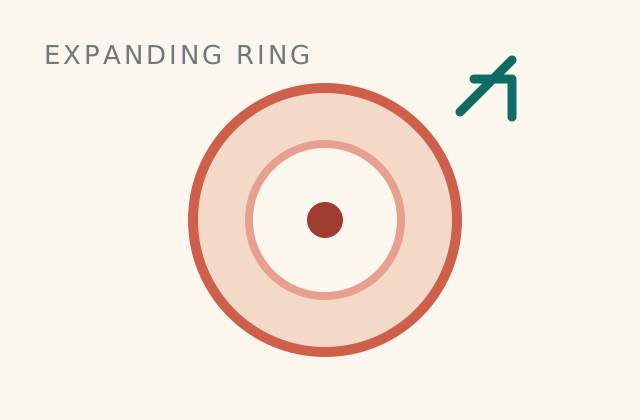
Ring-like redness should be treated as a safety signal, especially after outdoor exposure or possible tick contact.
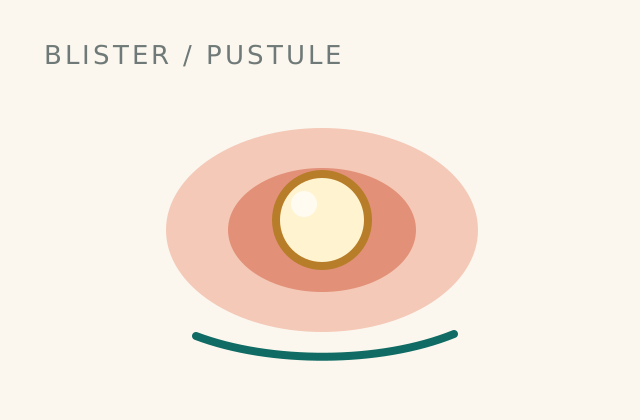
Some stings, fire ant reactions, irritation, or infection-like changes can create a raised or fluid-looking center.
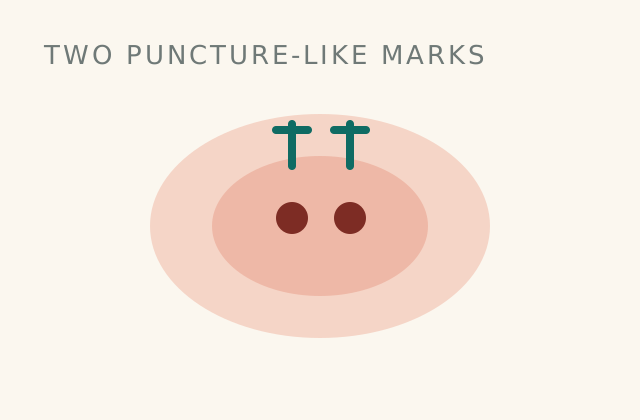
Two marks are not enough to confirm a spider bite. Skin irritation, scratches, or infected spots can mimic the same pattern.
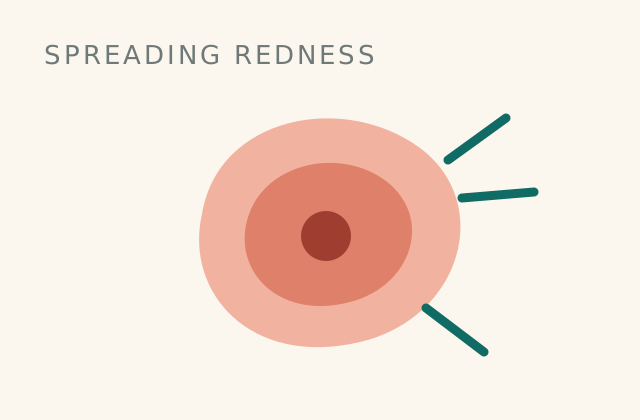
A growing red area can be more important than the insect name because it may point to infection or a stronger reaction.
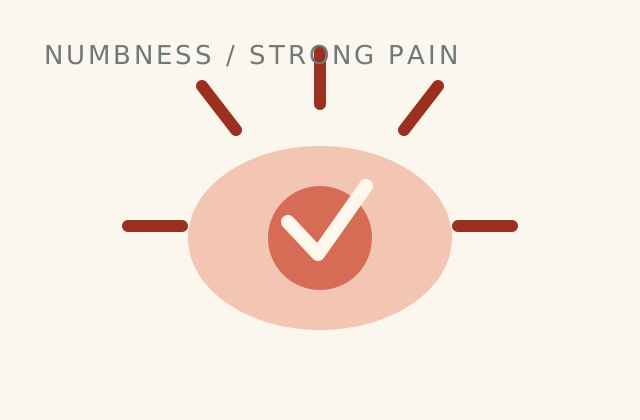
Sensation clues help separate a mild itchy bump from a reaction that deserves closer medical attention.
StingloBug bite identifier comparison table for common bite types.
This bug bite identifier table separates appearance, symptoms, common locations, helpful clues, uncertainty, and red flags so one visual cue does not carry too much weight.
| Bite type | Appearance | Symptoms | Location | Helpful clues | Uncertainty | Watch for |
|---|---|---|---|---|---|---|
Mosquito bite Possible | Raised bump with a soft red halo, often isolated or in loose groups. | Itching is common; pain is usually mild unless swelling becomes larger. | Exposed skin such as arms and legs. | The mark appears on exposed skin soon after outdoor time and stays mostly isolated. | There are new clusters after sleep, ankle-only marks, severe pain, or rapid spreading. | Large swelling, increasing warmth, fever, or signs that the area is getting worse. |
Bed bug bites Compare | Several marks, sometimes clustered, zigzagged, or line-like. | Itching, delayed swelling, variable reaction. | Exposed areas during sleep. | New itchy marks appear after sleep on exposed skin, especially in groups or lines. | Only one bump appears outdoors or marks are limited to ankles near pets. | New marks over several mornings, household exposure, and any signs of infection from scratching. |
Flea bites Compare | Small red bumps, often in groups, sometimes with a tiny central point. | Itching can be strong; swelling varies by skin reaction. | Ankles, lower legs, waistline, or areas near pets and carpets. | Small itchy groups appear around ankles, lower legs, pets, carpets, or upholstery. | Marks are on the upper body after sleep or include a large painful swelling. | Intense itching, spreading redness from scratching, or repeated new spots after exposure. |
Tick bites Watch closely | Small punctum, lingering red spot, attached tick history, or expanding ring-like redness. | May be mild at first; fever, rash, or spreading redness needs medical review. | Scalp, armpits, groin, behind knees, waistline, or outdoor-exposed skin. | There was outdoor exposure, an attached tick, or a bite in hidden folds or hairline areas. | There is no outdoor or tick exposure and the mark fades quickly like a mild bump. | Expanding rash, fever, headache, body aches, or symptoms that appear days after exposure. |
Spider-like bite Uncertain | One tender spot, sometimes with a central mark or localized swelling. | Pain, warmth, or spreading redness should be watched rather than guessed from a photo. | Areas exposed near storage, bedding, clothing, or outdoor spaces. | A single tender mark appears after contact with storage areas, clothing, bedding, or outdoor spaces. | The mark is one of many itchy bumps or there is no pain, warmth, or localized tenderness. | Severe pain, worsening warmth, spreading redness, blistering, or symptoms beyond the skin. |
Ant or fire ant sting Watch | Red bumps that may form small fluid-filled centers, often in multiple spots. | Burning or stinging first, then itching or tenderness. | Feet, ankles, hands, or skin exposed outdoors. | Burning starts quickly after outdoor exposure and multiple spots appear on feet, ankles, or hands. | The spots appeared after sleep or are limited to a single itchy bump. | Call local emergency services for breathing trouble or mouth or throat swelling. Seek urgent medical help for widespread hives, fast-worsening swelling, or signs of infection. |
Bee or wasp sting Watch | Central sting mark with swelling, redness, and sometimes a larger local reaction. | Immediate pain or burning; breathing trouble or mouth or throat swelling requires emergency help. | Hands, arms, legs, face, or other exposed areas outdoors. | There was an immediate sting, sharp pain, or a visible insect encounter outdoors. | The mark appeared much later without a known sting or looks like several tiny itchy bumps. | Call local emergency services for trouble breathing, swelling of the lips, mouth, tongue, or throat, fainting, or sudden severe dizziness. Seek urgent medical help for widespread hives or fast-worsening swelling. |
Mite, scabies, or chigger-like marks Compare | Tiny bumps, grouped spots, or very itchy areas that may not show a clear punctum. | Itching can be intense and may be worse with warmth or at night. | Skin folds, waistline, ankles, wrists, or areas under tight clothing. | Very itchy small marks appear in folds, under tight clothing, or after grass or bedding exposure. | There is one large painful swollen area or an obvious single sting event. | Persistent intense itching, spreading rash, household spread, or signs the skin is infected. |
StingloWhy a bug bite identifier needs more than a photo.
A bite photo can be useful, but a responsible bug bite identifier needs context. This section explains why Stinglo asks for location, sensation, duration, and change over time instead of returning a single certain insect name.
Mosquito, flea, bed bug, mite, sting, irritation, and infection-like changes can all look red, itchy, swollen, or clustered.
Outdoor time, pets, bedding, travel, yard work, clothing, and household patterns can change which comparison is more plausible.
Pain, warmth, fever, fainting, sudden severe dizziness, mouth or throat swelling, breathing trouble, or fast spreading redness matter more than a visual match.
Stinglo can structure what you see and what to watch, but it cannot confirm infection, allergy, tick illness, or the exact insect.
StingloBug bite identifier watch plan for the next 24-48 hours.
Many minor bites are monitored over time. This bug bite identifier turns the result into a short observation framework so users know what to compare next without panic.
Take a clear baseline photo, note the location and sensation, and check whether any urgent red flags are already present.
Compare size, redness, warmth, swelling, pain, and itch. A fading mark is different from one that is expanding or becoming more painful.
Seek medical advice if symptoms worsen, redness spreads, pus appears, fever develops, or the bite came with possible tick exposure and rash.
StingloBug bite identifier red flags: when to seek care.
A bug bite identifier should never downplay urgent signals. Call local emergency services for trouble breathing, mouth or throat swelling, fainting, or sudden severe dizziness. Seek urgent medical help for fever, pus, severe pain, red streaks, rapidly spreading redness, or a rash after possible tick exposure.
StingloFAQ
Direct answers for common bug bite identifier, photo, and symptom questions.
Use Stinglo to compare visible patterns, check safety signals, and decide what to watch next.